
It can be hard to enjoy even the simplest things these days.
The weight of the world can feel overwhelming at times, what with all this disaster that seems to be eddying violently about us. President Trump’s distinct tendency to inject himself into whatever he can poisons anything and everything we might consider good or worthwhile only makes matters worse. His benighted intervention in the World Cup, for instance, transmogrified what had been an entertaining and uplifting run by the American soccer team into an exercise in rank corruption, and turned America’s semiquintennial celebrations into a listless and flaccid affair.
It’s a malaise that goes well beyond Trump’s personal craving to make everything about him. Take the recent Artemis II mission: America and the world experienced a brief spurt of joy as four astronauts traveled back to the Moon for the first time in more than five decades. But the Trump White House and its NASA administrator appear determined to disembowel the Artemis program and dismantle America’s space exploration program as a whole, replacing it with half-baked fantasies of Moon bases and giveaways to private companies like Elon Musk’s SpaceX.
But there’s one shared experience that’s managed to escape this fate: live music and concerts.
If the shows I’ve attended since the start of the year are any indication, there’s something new and different happening at these shows: a greater and much more acute awareness and understanding of the communal nature of these experiences, especially among artists and performers themselves. This sort of consciousness has always of course existed, and in my own experience it reached an apotheosis with Taylor Swift’s Eras Tour of 2023 and 2024. These more recent shows can’t compare to that once-in-a-lifetime tour, of course, or the palpable camaraderie and enthusiasm it kindled. But they have offered a sanctuary from the madness that threatens to engulf us—as well as a reminder that we have much more in common than we believe.
Indeed, live music can help us remember that we remain social creatures that share a common nature—and that we lose something important when sever ourselves from one another and we give into our baser instincts. As Evanescence lead vocalist Amy Lee told the metalheads gathered for her band’s recent show in the Washington, DC area, these gatherings prove that “we’re not cooked”—at least not yet, at any rate, and we can’t forget that.
No matter the artist or the genre or the character of the audience or the size of the venue, it’s a sentiment that I’ve found both implicitly and explicitly at the concerts I’ve seen over the past six months. At a time when we seem dedicated to pulling ourselves apart and our political leaders profit from pitting us against one another, we need the sense of togetherness and basic human connection that live music can give us—now more than ever.
I’d seen Nine Inch Nails back in Minnesota not six months before Trent Reznor’s electro-industrial rock behemoth made its way to Washington, DC for a February concert. It’s a musical project that’s always attracted alienated misfits and oddballs, so it’s not exactly shocking that there’d be a certain affinity among those attending one of the band’s concerts. Seeing as this is DC, though, Reznor took the time to give us a topical introduction to his cover of David Bowie’s “I’m Afraid of Americans”: “As the world gets weirder and more fucked up and more unrecognizable seemingly every minute, it is a privilege to be in a place where I feel connected to an audience and we can fucking express something and be present in the moment, so thank you for being here.” Not an explicitly political statement by any means, but an unmistakable one given the circumstances.
A little more than two months later, and I’m at a late spring rite put on by Florence + the Machine. It’s a communal experience from the very start, with lead singer Florence Welch traipsing across the stage like a gothic fairy queen in a flowing black dress and bare feet. A song like “Shake It Out” captures the feeling of the concert as something of a collective exorcism, casting out all of our bad vibes—minus the incense and sage that typically accompany these sorts of rituals. Shared catharsis indeed seems to be the order of the day here, with Florence working the crowd on new songs like the passionately introspective acoustic track “Buckle” and effervescent resilience of the magnificent “Sympathy Magic.” And she also emphasized the immediate nature of the experience on “Dog Days Are Over,” urging the audience to put away our phones, remember why we’re here, and live fully in this particular moment.
Soon enough, it’s outdoor concert season—and first up, a soggy but sold-out performance by Sting at Wolf Trap National Park for the Performing Arts. The damp atmosphere somehow adds to the intimacy and enhances the storytelling vibe as Sting remarks how much the drizzly weather reminds him of England. His setlist runs the gamut of his work with the Police and as a solo artist, and lyrics like “I have stood here before inside the pouring rain” hit different when a good chunk of the audience is, in fact, sitting outside and listening to live rendition of “King of Pain.” It’s not nostalgia, precisely, but songs like “Fields of Gold” cultivate a warm and comfortable ambiance that transports us away from our cool and wet reality, at least for a moment. I’m back at Wolf Trap again a little over two weeks later to catch guitar virtuoso Gary Clark, Jr. with some friends; Clark draws us all in and demands our complete attention with his intense guitar work, letting his skill speak more than his restrained stage presence.
In between, there’s Bruce Springsteen’s Land of Hopes and Dreams tour at Nationals Park—a series of concerts mounted as an explicit act of opposition to the Trump presidency. Unlike the other shows I’ve seen this year, this one’s overtly political in nature—and not like that’s unexpected given Springsteen’s extensive body of work and well-known political commitments. (The man staged a series of shows with R.E.M. to oppose President George W. Bush’s re-election in 2004, after all.) But it’s more an act of solidarity than one of protest, with politically inflected songs alternating with more upbeat numbers to create a collective celebration at a dark and lonely moment in American history. Not that you’d expect anything else from Springsteen and his generations of loyal fans, all of whom know the lyrics to songs like “Badlands” and belt them out along with the Boss.
Come the end of June, and it’s time for Evanescence out at Jiffy Lube Live amphitheater. The venue is perfectly fine, albeit out in what passes for the sticks of northern Virginia. Parking, however, is atrocious, and we all spend almost as much time trying to get out as we do at the show itself. It’s a gathering of more casual fans of the band like me and some hardcore metalheads, an evening that draws us all together and underscores what we have in common. Through her dark and operatic vocals, lead singer Amy Lee tells tales of modern despair laced with traces of hope (if not exactly optimism) over crunching metal guitar riffs and delicate pianos on songs like the classic “Bring Me To Life” and the recent “Who Will You Follow.” Like other performers, takes pains to remind her audience that they’re bound together in a shared enterprise that encourages fellow-feeling and connection—and to “remember that later when you need courage.”
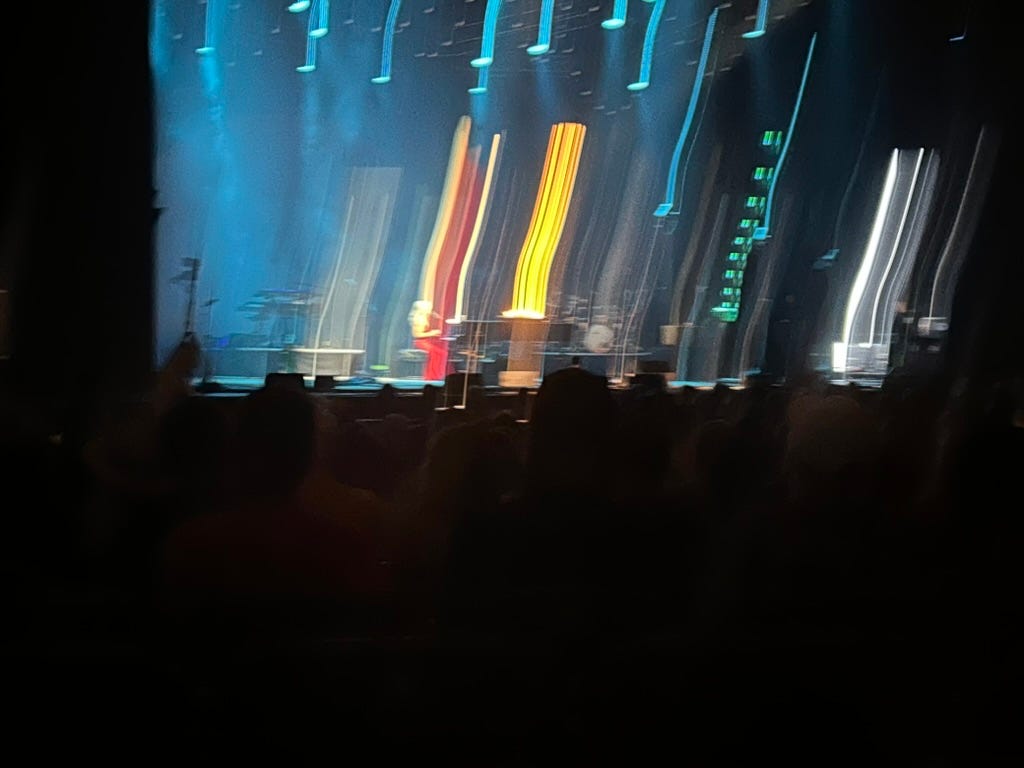
If there’s any one artist I’ve seen this year who understands how live music can bring people together, it’s the last one I’ve seen: Sarah McLachlan, the Canadian singer-songwriter who organized the Lilith Fair festival some three decades ago. She touches on politics only briefly during her feminist anthem “One In a Long Line,” but she’s otherwise more than cognizant of the way concerts allow for the sort of uplifting communal experiences that are few and far between these days—to say nothing of why such occasions remain vitally important.
In short, live music has become a sanctuary in a world that seems intent on disintegrating and dissolving the ties that bind us together as a society. The way that concerts and musical performances create bonds and a sense of community among otherwise disparate individuals has been long known, but artists and performers have become far more willing to state the need for these connections outright. In that respect, they offer an implicit rebuke to our current president and how much he’s corroded our public life after less than two years back in office—even if politics itself remains largely unspoken or barely whispered.
That doesn’t say anything terribly good about the state of America today: once normal activities and social gatherings now represent a sort of opposition to the powers that be, whether desired and intended or not. It’s not exactly the mark of a healthy society, to say the least.
Still, the fact artists and audiences alike have articulated and become aware of this sentiment does tell us that we are, despite everything, not in fact cooked—and that there may still be some hope for us yet.