
If You Would Progress, Conserve
An argument for conservative liberalism in an age of revolutionary reaction

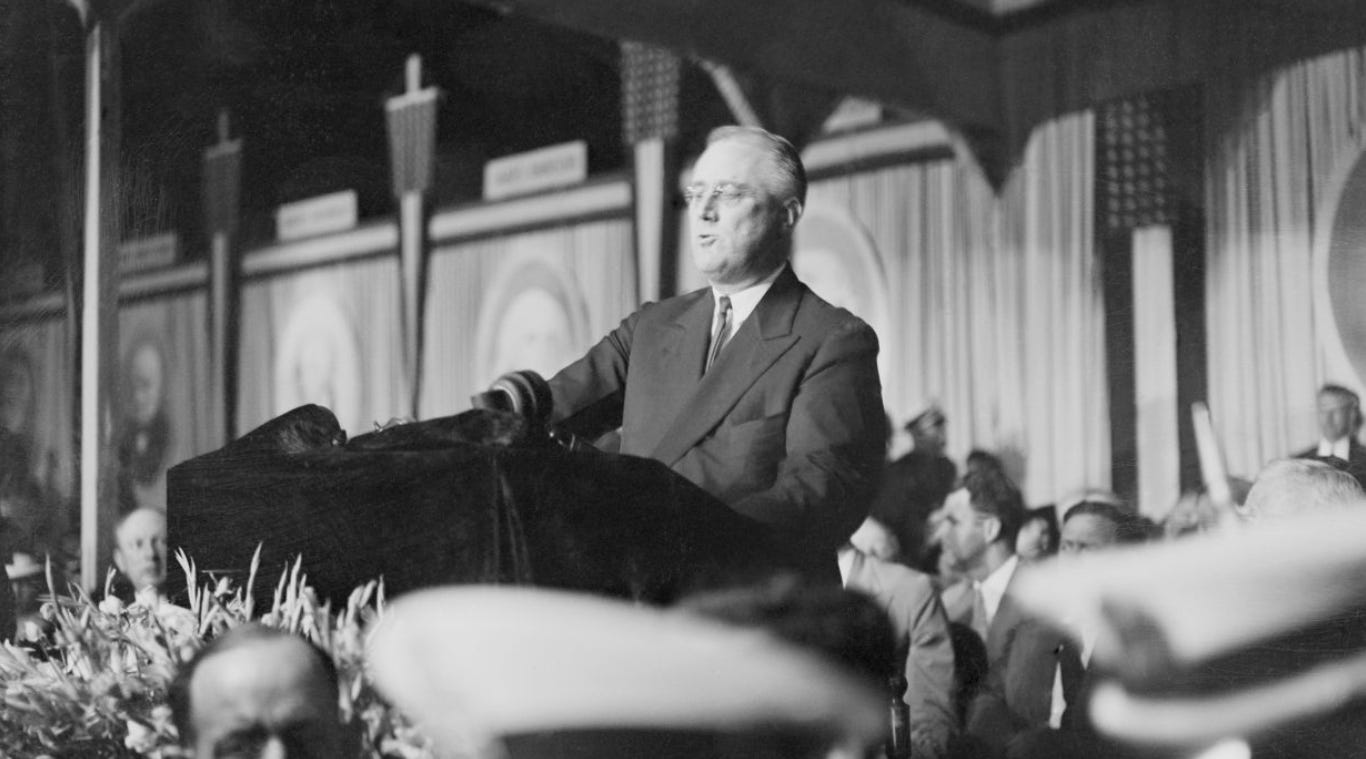
Late in his 1936 reelection campaign, President Franklin D. Roosevelt stopped by the New York state Democratic Party’s convention to stump for the statewide ticket and deliver a spirited defense of his New Deal against the scurrilous charges made by his right-wing political opponents and propagandists. Indeed, Roosevelt sought in his remarks to distinguish between the “far-sighted conservative” who saw New Deal liberalism as a prudent bulwark against the forces that stood to undermine private property, free enterprise, and above all American democracy itself. As Roosevelt envisaged it, New Deal liberalism was a means of preserving the worthwhile political and economic institutions of American democracy against the tumult of the modern, industrial world—what he earlier called “faith—in the essential soundness of democracy in the midst of dictatorships.”
For all the real changes the New Deal brought to the United States, Roosevelt’s vision of liberalism was in many ways deeply conservative: more than anything else, he sought to preserve and protect the institutions and practices of democratic government in the face of acute threats from the communist left and—especially—the fascist right. As he told the state party delegates assembled in Syracuse, “worthy institutions can be conserved only by adjusting them to the changing time.” Roosevelt knew and understood that America’s traditional liberal values needed to be recast to meet the challenges and problems posed both at home and abroad by the industrial, scientific, and technological revolutions that swept the world starting in the late nineteenth century.
Though Roosevelt had an obvious political purpose in his disquisition, his remarks called attention to the truth that ideological lines can blur and definitions falter even when fundamental moral and intellectual principles remain constant.
In the here and now, however, American liberals confront a somewhat different task: conserving the very political, economic, and social arrangements Roosevelt and his successors built to respond to the profound and permanent changes wrought and challenges created by the industrial age—and redeem the promise of American democracy for all its people, no matter their race, religion, or creed—in the face of a president and political movement that seeks to destroy them by whatever means available.
Contemporary liberals must accordingly draw on a more philosophical form of conservatism, one that understands the programs and policies enacted over the course of the twentieth century exist for very good reasons and should not be demolished absent a real understanding as to why they were created in the first place. The Federal Reserve, social insurance programs like Social Security and Medicare, civil and voting rights laws, alliances like NATO overseas and active American involvement in global affairs more generally—all these programs and policies came into being as practical measures meant to solve, or at least substantially address, enduring problems in American society and international affairs that had become apparent and often acute in the early decades of the last century.
The Supreme Court’s latest assault on the Voting Rights Act of 1965 is case in point: it has eviscerated a law designed to redress a malignant wrong at the tortured heart of American democracy—namely, how to guarantee all Americans the right to vote and effective political representation. In part, law has cashed out in practical terms into the creation of “majority-minority” districts that can be hard to defend as a matter of abstract principle. But awareness of an iota of American history ought to make anyone with the barest of commitments to liberal and democratic principles reluctant to even think about tinkering around the edges of the Voting Rights Act, to say nothing of tearing its guts out. This law exists for very good reason, and America cannot dispose of it as cavalierly as the Supreme Court’s reactionary majority seems to believe.
It’s entirely unnecessary to spout Faulknerian shibboleths about the past not even being past to develop strong and healthy reservations about tampering with such an essential, load-bearing pillar of American democracy.
This disposition of conservative liberalism can and should be applied across the board to just about every facet and aspect of the Trump administration’s ongoing campaign to repeal the twentieth century. Trump’s ingrained antipathy toward alliances like NATO and lifelong disdain for international trade, his Republican Party’s attempts to gut or repeal social insurance programs like Medicaid, and the Supreme Court’s attacks on fundamental rights are all of a piece with both Trump’s own fascist inclinations and his political movement’s project of revolutionary reaction.
Under such circumstances, it’s incumbent upon liberals to take on the mantle of true conservatism: preserving and protecting the great domestic and international achievements of the twentieth century against radical attempts to dismantle and destroy them. Modern liberalism, in other words, must become a shield against change for the worse, understanding that the political, social, and economic arrangements founded over the course of the past century exist for very good reasons. Unlike traditional variants of conservatism that prize tradition or appeal to a supposed “natural order” for their own sakes, moreover, liberals can clearly articulate the reasons their policies and programs arose in the first place. At its most basic, this sort of conservative liberalism amounts to an acknowledgement that progress itself must be conserved—not least against the reactionary fantasies of Trump, his political movement, and the contemporary American right more broadly.
In that sense, at least, liberals ought to embrace their own inner conservatism without reservation or apology. A true liberal does not crave change in and of itself, but rather strives to maintain the progress Americans won in the past—often at great cost—so as to make further progress toward a better future.
None of that means that each and every institution, practice, or policy must be defended; indeed, many must be challenged and changed—some of them drastically—in order to undertake the very conservation work that sits at the heart of modern liberalism. Nor is it to caution against fresh, creative thinking about how best to address our current and future national predicament or how to pick up the pieces when Trump’s demolition job finally comes to an end.
In many cases, however, there’s simply no need to reinvent the wheel—rather, liberals need to rediscover and better express the reasons and rationales behind the policies, programs, and arrangements we aim to preserve. These reasons and rationales will not vanish, and they will need to be answered or addressed by active, vigorous public policy in one way or another. The industrial, technological, and scientific world in which we’ve lived since the late nineteenth century abhors this sort of political and policy vacuum. But liberals can no longer complacently coast on the rapidly fading collective memory of the world as it was before America updated and adapted its traditional liberal principles to meet the domestic and foreign challenges posed by the modern age.
To paraphrase Roosevelt’s own conclusion in his 1936 address, today’s wise and prudent liberal ought to recognize that we must preserve past progress if we would reform in the future—an axiom all the more vital to comprehend when we’re confronted with a reactionary president and political movement hellbent on repealing the twentieth century. Worthy institutions and arrangements can only be adjusted or reformed to adapt to changing circumstances if they are conserved for the future. Like Franklin D. Roosevelt, we ought to be this kind of conservative today because we are that kind of liberal.
Excellent piece! :)
I think what has hurt Democrats over the last decade, in response to the rise of Trump, is their reflexive defense of institutions without any acknowledgement that they may need reform.
In 2028, we should be running a Democrat who can credibly claim to be an outsider who can fix Washington, DC. In hindsight, Clinton in 2016 and Harris in 2024 were dispositionally never up to that task (and even Biden, who narrowly won in 2020, didn't talk about the need to rethink the federal government).