Plain, Simple Murder
Trump's gangster regime plumbs the depths of moral depravity and damages American national security with its Caribbean killing spree

With “doing a Sicario” in Mexico evidently too idiotic even for this crew, the Trump administration has now mounted ten strikes against apparently random boats plying the waters of the Caribbean and Pacific off the coast of South America as part of a lawless and immoral military campaign purportedly against drug traffickers and cartels. It’s a campaign that’s the arbitrary action of an aspiring despot who seems to think he has license to kill whoever he wants, wherever he wants, and however he sees fit for any reason—or no real reason whatsoever. These strikes and the flimsy, morally insulting rationales offered on their behalf both clearly express and aptly encapsulate essential depravity and nihilism that animate this administration at its rotten core.
But Trump’s military campaign in the Caribbean isn’t just a moral abomination—it will probably set American relations with Latin America back decades. Making matters somehow even worse, it’ll be much more difficult to repair the strategic damage done by these strikes—much less the possible war with Venezuela the Trump administration seems intent on launching. As much harm as Trump has done and will continue to do to America’s relationships with its long-time allies in Europe and the Pacific, there’s an enduring strategic logic to these ties on both sides that will compel at least a strenuous attempt to rebuild them once Trump leaves the scene. Not so in Latin America, where there’s a latent reservoir of anti-American sentiment and no similarly potent strategic reasons for Latin American nations to set aside Trump’s trespasses and resume constructive, cooperative relations with the United States.
To justify this rolling atrocity, Trump and his minions have stretched the English language to meaninglessness. Words here do not serve to provide an accurate description of the world or convey truth and meaning, but instead assume a purely instrumental function with no real relationship to either reality or veracity. It’s not even an Orwellian inversion of language, where war is peace and freedom slavery—words and phrases are stripped of meaning and reference to the real world as they’re press-ganged into the service of arbitrary and despotic power.
This sort of rhetorical nihilism and linguistic absurdism is embedded in the genetic code of the Trump administration and the political movement that supports it: immigration somehow constitutes an “invasion” that allows the suspension of civil liberties, popular protests and political opposition amounts to an “insurrection” that permits Trump to deploy active-duty troops in American cities, claiming these “war-ravaged” cities suffer from a crime wave unprecedented in modern American history that necessitates just such a deployment, screaming “weaponization” as the administration aims to sic law enforcement on its enemies as it purges intelligence agencies—the list goes on and on.
It’s certainly at play in the Caribbean as well, where reality has become the first casualty of the administration’s very own special military operation. Trump asserts the United States is engaged in a “non-international armed conflict” with drug cartels, calling them the “ISIS of the Western Hemisphere” and those killed by his strikes “narco-terrorists.” (Colombian President Gustavo Petro and locals in the Caribbean say these strikes have mainly murdered fishermen.) He has also risibly claimed that his campaign targets fentanyl smuggling routes—never mind that most fentanyl comes to the United States through Mexico or that marijuana and cocaine are the main drugs smuggled via the Caribbean. Secretary of Defense Pete Hegseth likewise vowed to “treat [drug traffickers] like we treat al Qaeda.”
The president and his administration now find themselves trapped in a hall of mirrors of their own design and construction, so consumed by their delusions that they are now engaging in wanton murder on the high seas. They have dismissed or forced out those who have questioned the legality of their actions under either American or international law; Admiral Alvin Holsey, head of U.S. Southern Command, stepped down from his post less than one year into a three-year appointment after he reportedly “had raised concerns” about the legality administration’s campaign in the Caribbean. Other questions about the legality of the strikes have gone unanswered in no small part because “career military and civilian lawyers in the Defense Department and lawyers at other agencies who might otherwise be involved in the deliberations have left government or been excluded from the discussions.”
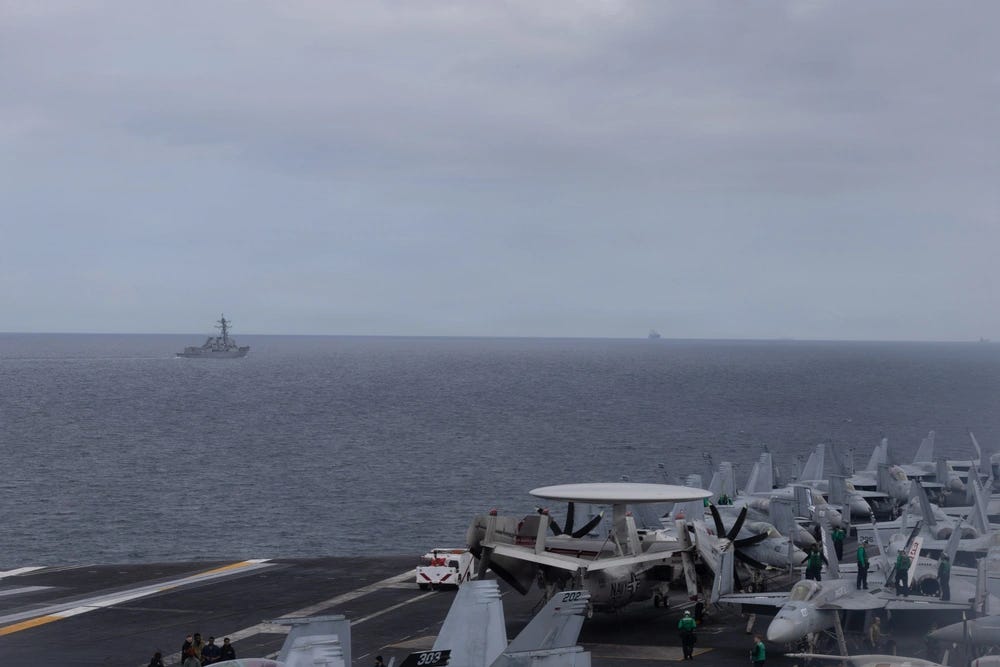
Worse still, the Trump administration’s fantasies may lead to an outright war with Venezuela. Trump has already threatened to carry out strikes against supposed drug-related facilities in Venezuela, and to that apparent end the U.S. military has engaged in a significant build-up in the Caribbean that includes displays of force by strategic bombers and the diversion of a carrier strike group from its deployment to Europe as well as F-35 stealth fighters, AC-130 gunships, and a Marine expeditionary unit.
If Trump does in fact launch strikes against targets in Venezuela, the resulting war will not even have been sold on false or misleading pretense—it will have been sold on completely imaginary ones. He and his administration will have conjured up a crisis out of thin air, presumably to allow them to do whatever it is they want. The sleep of reason produces monsters indeed.
The strategic consequences of Trump’s Caribbean murder spree are not quite so dire as the moral ones, but they’re significant nonetheless. Let’s start with the rather large opportunity costs involved in the diversion of attention and resources from much larger and more important strategic priorities in Europe and the Pacific. Instead of deterring Russia or reassuring allies like Japan, American bombers and patrol jets are buzzing the Venezuelan coast while an American carrier strike group must now rush back to the Caribbean from its current European cruise. America’s depleted and demoralized intelligence agencies must now focus their diminished energies on the Trump administration’s quixotic military campaign.
Deeper damage has already been done to America’s relations with Latin America. Colombian President Gustavo Petro’s harsh criticism of Trump’s strikes, for instance, has been met with a petulant response from the Trump administration: Trump cut off American military aid to Colombia, a long-time recipient of security assistance given its own fight against drug cartels, and slapped sanctions on Petro himself. It’s a move that only undermines the wider international effort against drug trafficking, one that illustrates Trump’s own detachment from reality and gives the lie to his claims that his strikes are meant to stanch the flow of drugs from the region.
Beyond this immediate self-inflicted wound, however, Trump’s strikes will likely do lasting generational damage to America’s reputation in Latin America. The region itself has always possessed a strong anti-American streak for a variety of reasons, and the current, unjustified military campaign will only bring this vestigial trait to the fore. It all comes at a time when Beijing is investing heavily in Latin America and the region itself is taking advantage of Trump’s tariff fetish to replace, among other things, American soybean exports to China. What’s more, Latin America possesses many of the critical minerals the Trump administration says it wants to secure against Beijing’s attempts to secure and leverage a de facto monopoly on them.
All in all, it’s an insane and brainless response to a problem that would best be addressed by increased law enforcement efforts (such as more resources for the Coast Guard) and greater security cooperation with partners in and across Latin America.
Faced with an irrational military campaign ordered by a lawless president, what can be done?
First and foremost, we can speak plainly and truthfully: these strikes are illegal and immoral, criminal from top to bottom. Sen. Ruben Gallego of Arizona, a combat veteran, has provided an example that can be emulated, calling Trump’s strikes “murder. It’s very simple.” A possible war with Venezuela would be even worse, a war crime in and of itself morally and legally both at the domestic and international levels. We shouldn’t hesitate to describe these acts for what they are: criminal and immoral and irrational, or whatever other terms one might wish apply.
There will also need to be formal legal accountability for Trump’s strikes, starting at the top but going all the way down to those who may believe they’re just following orders. Blowing random boats out of the water and launching a full-blown war against another nation in the absence of any legal, strategic, or moral rationale should obviously be an offense worthy of impeachment and removal from office. And Secretary of Defense Hegseth appears to actively support war crimes, having successfully sought a presidential pardon for a notorious war criminal, rehabilitated the perpetrators of the massacre at Wounded Knee, and consistently and constantly attacks military rules of engagement based on the laws of war as “politically correct” barriers to “maximum lethality.”
Rank-and-file members of the military are right to be concerned about the dubious legality of these strikes. Such concerns may well have forced the SOUTHCOM chief into an early retirement, while Democratic staffers in Congress told reporters they’ve been “hearing from inside the Pentagon that individuals have been raising liability issues.” Some junior officers have reportedly requested but did not receive written legal approval before participating in the strikes.
As hard as it will be to repair the strategic damage done by these strikes, the moral rot will prove even more difficult to expurgate. We need to start with the recognition that we’re not dealing with bad faith here, but rather no faith at all beyond a belief in the supreme and arbitrary prerogatives of raw, unencumbered power. But we must also reassert our own firm belief in the notion that words do, in fact, mean things, whether they’re meant to describe reality in some aspect or express a particular truth—and act on that belief. At minimum, we can’t let ourselves succumb to a nihilism of our own and fall into the event horizon of the supermassive moral black hole created by the current administration.
That’s not to doom by any means—though things do certainly seem bleak right now, and they only seem to get bleaker by the day. It’s instead a call to once again carry the fire and keep the flames of truth and reason alive, as candles in the dark that can help guide us back to the light when the chasm between reality and fantasy becomes too gaping to ignore.