
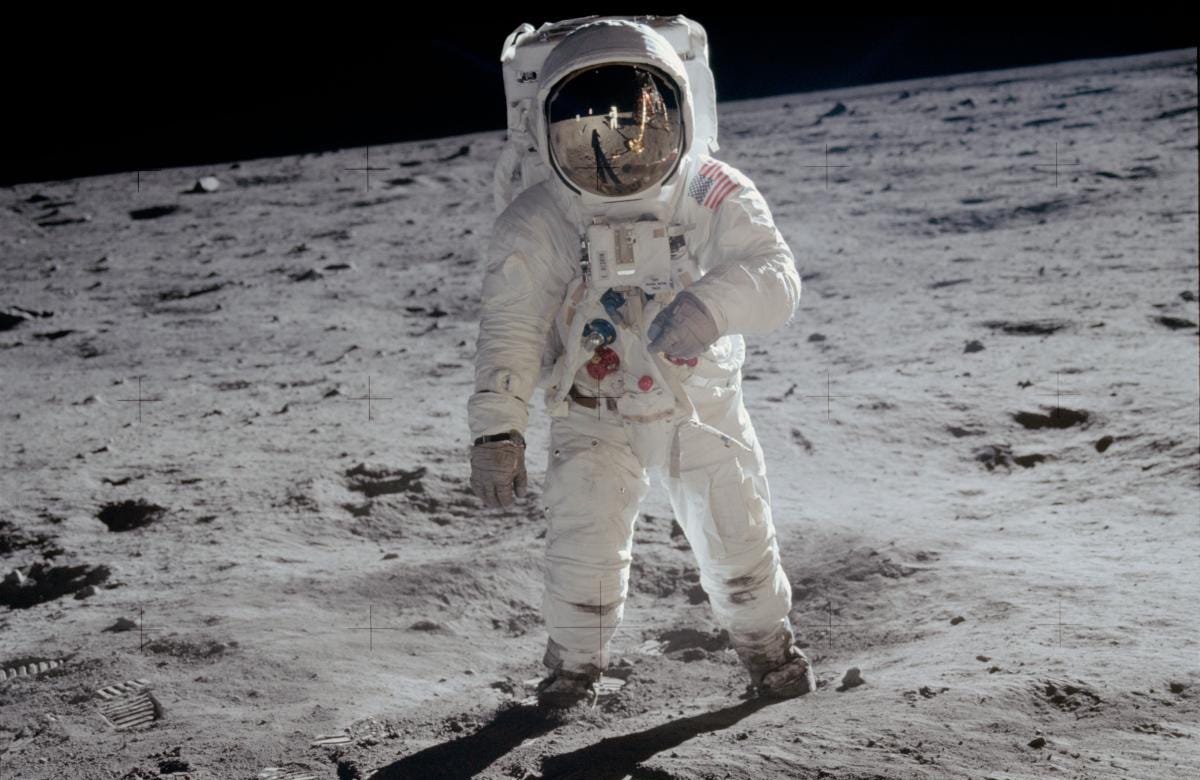
On this day 57 years ago, American astronauts Neil Armstrong and Buzz Aldrin became the first humans to set foot on another world when they stepped off the lunar lander Eagle and onto the Sea of Tranquility.
I’m on the road this weekend and have got an extra spot for a post this month, so in lieu of a longer piece I thought I’d write up a short list of best things I’ve read or watched on Apollo 11 and the larger national effort to put an American on the Moon by the end of the 1960s.
Enjoy!
Best Overall: If you only read or watch one piece of media about Apollo, make it Apollo 11—the excellent 2019 documentary by Todd Douglas Miller. It’s a cinematic wonder that lets the mission speak for itself, using digitally restored footage, mission audio, and an innovative score from composer Matt Morton that uses only instruments available in July 1969. Apollo 11 focuses on the mission itself, of course, but also takes care to touch on its wider purpose and meaning while saluting the multitude of workers who made it possible to send three astronauts to the Moon, land two of them, and return them safely to the Earth. Of particular note is the spectacular launch sequence and the thundering score that perfectly accompanies it. Check out a longer review here!
Best Memoir: Apollo 11 command module pilot Michael Collins didn’t just write the best astronaut memoir with Carrying the Fire—he wrote one of the best books about human spaceflight and space exploration, period. It’s also a fascinating window into life during the middle of the twentieth century, with Collins relating his upbringing as the son of a diplomat and then a fighter and test pilot before becoming an astronaut. Collins had a literary and intellectual bent, and it comes through loud and clear in a memoir that’s equally at ease explaining orbital mechanics to lay readers, providing insightful character sketches of fellow astronauts, and delving into the ultimate meaning of humanity’s first voyage to another world.
Best Biography: Historian James Hansen’s biography of Neil Armstrong, First Man, is at the top of my list—mainly because it gives a good sense of why Armstrong was the right person to be the first man on the Moon. Hansen’s prose isn’t spectacular, but it does get the job done; Armstrong’s quiet and conscientious nature made him a great pilot and excellent choice to command the first lunar landing. More importantly, this innate reserve kept Armstrong from imposing his own meaning and interpretation on Apollo 11. In that respect, he gave the rest of humanity—present and future—the opportunity to determine just what his small step onto the lunar surface would mean. For a longer explanation, check out my review here.
Best on Politics: As the line in the 1983 film The Right Stuff goes, “No bucks, no Buck Rodgers.” Domestic and international politics drove the United States to first commit to landing an astronaut on the Moon by the end of the 1960s and then kept the effort on track despite setbacks and other national priorities. Historian Douglas Brinkley’s readable account American Moonshot: John F. Kennedy and the Great Space Race posits that Apollo wouldn’t have happened—at least not how it did—had it not been for President Kennedy’s ambitious personality and concern for international prestige. Brinkley’s narrative doesn’t go much past Kennedy’s own assassination in 1963, but the book does provide a solid discussion of the political and foreign policy considerations that impelled Kennedy to set Apollo into motion—and ties it into the wider streams of mid-century American liberalism as a political and governing philosophy. See my review here.
Best Overview: Andrew Chaikin’s 1993 A Man on the Moon remains probably the best overall account of the Apollo program as a whole, from its inception to the final splashdown of Apollo 17 at the end of 1972. Chaikin covers virtually every aspect of the program: astronauts, missions, science, training—you name it, it’s probably in the book. If a little weak on the politics of space exploration and somewhat less informative about the physics of spaceflight than, say, Carrying the Fire, A Man on the Moon does do an excellent job conveying the sheer physical strain involved in exploring the Moon on foot as well as explaining the scientific knowledge gained during Apollo. It’s not at all hard to understand why this book served as the foundation for the Tom Hanks-produced 1998 miniseries From the Earth to the Moon.