Bring Out Your Dead
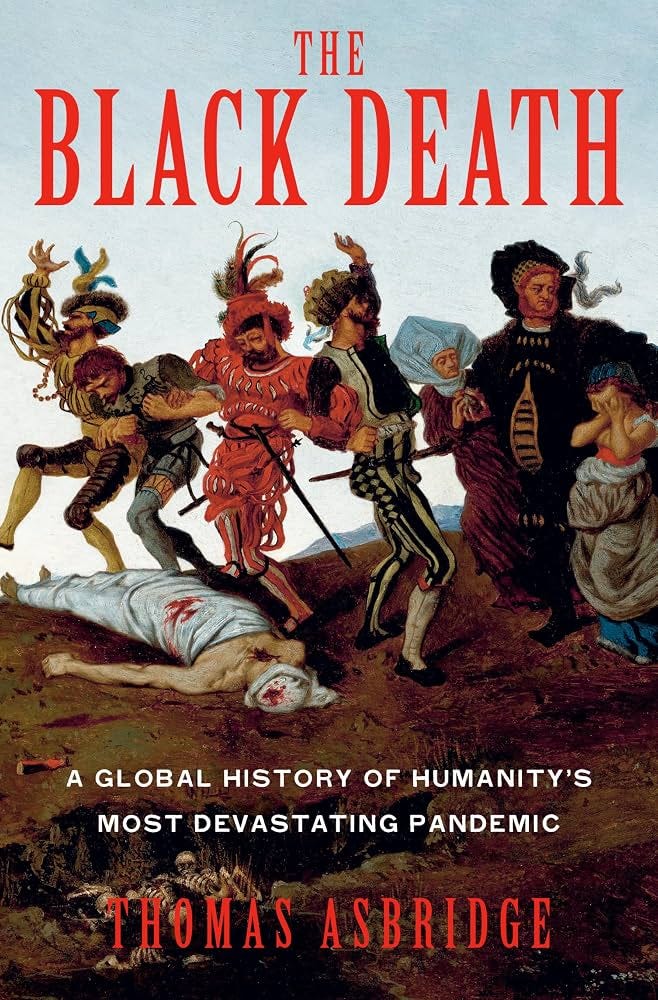
A review of Thomas Asbridge's "The Black Death: A Global History of Humanity’s Most Devastating Pandemic"

Few natural disasters can match the sheer scope and scale of devastation the Black Death wrought in the middle of the fourteenth century. Over the course of six short years starting in 1347, the plague killed some 100 million people across Europe and the Middle East—roughly half the total population of this wide geographic expanse, a death toll rivaled only by the introduction of smallpox and other Old World diseases into the Americas after 1492. The vast sweep of this calamity helps explain why the Black Death still captures the popular imagination while other pandemics from the plague of Athens during the Peloponnesian War to the great influenza pandemic at the end of World War I vanished from collective consciousness almost as quickly as they arrived.
With The Black Death: A Global History of Humanity’s Most Devastating Pandemic, medievalist Thomas Asbridge offers a new, panoramic account of the Black Death, one goes well beyond the usual confines of narratives about this most terrible of plagues and reveals just how close it brought civilization to the brink of collapse. As in his earlier books—a superlative history of the Crusades and a biography of the English knight William Marshal—he uses personal, first-hand reports to put a human face on seemingly daunting and incomprehensible events. Asbridge supplements his narrative with the latest scientific findings about the plague’s origins and spread—findings far more recent than most readers might suspect.
It’s a book cleverly structured to put the reader in the proverbial shoes of the denizens of the medieval world as it confronted a horrific mass mortality—to give a sense of how individuals and societies perceived and reacted to the plague as it steamrolled across Europe and the Middle East over a relatively brief period. Only then does Asbridge proceed to delve into the science of the pandemic, exploring medieval medical knowledge and treatments (typically either ineffective or palliative) before detailing the modern scientific debates about the plague’s origins and nature. He concludes the book with a wide-ranging exploration of the Black Death’s immediate aftershocks on medieval politics, economics, and culture.
The Black Death was indeed a shocking event for the medieval world, unprecedented in the scope and scale of its devastation. Other plagues and pandemics had afflicted the ancient world, leaving their marks on the course of history by taking out political leaders like Pericles in ancient Athens or weakening empires like the Byzantium of Emperor Justinian. But for all the misery they caused, these diseases did not lead—in so far as we can tell from the historical record—to mass mortality to the extent of the Black Death. Societies across a broad geographical expanse stretching from England to Iraq had to manage and cope with this catastrophe as best they could.
When the Black Death hit, medical knowledge had barely advanced beyond the ideas put forward by the late second-century Roman physician Galen. Intellectuals living in the wider Muslim world built on Galen’s work as well as ancient Greek philosophy, with the erudite Persian scholar Ibn Sina and Cordoban thinker Ibn Rushd serving as the benchmark for medical knowledge across the Islamic Middle East and North Africa as well as Christian Europe. As Asbridge notes, this “shared medical heritage meant that physicians in both worlds tended to approach ailing patients in much the same way.” In practice, though, that meant leaving relevant authorities little real recourse to fight the pandemic in a meaningful way beyond trial and error.
For their part, plague-stricken Christians in Europe scapegoated their Jewish neighbors with a vengeance—despite stern condemnations of antisemitic violence from Pope Clement VI. These pogroms appear in many cases to have had pecuniary as well as paranoid, conspiratorial motives, with Christian mobs seizing valuables from the Jews they persecuted and conveniently destroying ledgers recording the debts they owed to Jewish lenders. All told, tens of thousands of Jews were killed in Western Europe during the convulsions of the Black Death, while long-standing Jewish communities were either destroyed entirely—Asbridge counts more than 200 wiped out by 1351—or left en masse for Eastern Europe as a result of this barbarism.
Muslim societies were hit even worse by the plague, with religious prohibitions against flight from disease combining with a rejection of the idea that the Black Death could be transmitted between humans to elevate the death toll across Islamic empires. Some eighty percent of the populations of both Cairo and Damascus died of plague, with possibly 20,000 Cairenes dying each day at the pandemic’s height in December 1348 and January 1349—leading Asbridge to conclude that “it may well be that Cairo suffered the most devastating mass mortality of any population center during the Black Death.” In time, moreover, the sheer amount of death Egypt experienced would come to have severe repercussions for the longevity of its ruling Mamluk empire.
But though it brought medieval civilization to the brink of outright collapse, Asbridge persuasively contends that the Black Death ultimately exposed the underlying resilience of societies and individuals in the face of an unimaginable cataclysm. Contrary to the assumptions that undergird much modern dystopian fiction as well as pessimistic contemporary accounts like Giovanni Boccaccio’s Decameron, medieval societies did not disintegrate under the considerable stress and weight of the plague—though some certainly came closer to unraveling than others.
However, this resilience didn’t lead to a smooth or rapid recovery. The plague returned in recurrent waves starting in the 1360s, conspiring with wars and climate change—reduced solar activity and increased volcanic activity led to the onset of the “Little Ice Age” starting in the late thirteenth century—to prevent populations ravaged by the Black Death’s first wave from recovering for decades. England, for instance, saw its population crash from 4.8 million before the Black Death to a low of 1.9 million in 1450; Florence’s population declined from between 90,000 and 100,000 to just 37,000 in 1427. No surprise, then, that the plague pandemic had consequences that rippled out across the decades and even centuries that followed.
In the wake of the plague, lower classes found themselves with increased bargaining power that they sought to use—leading to revolts from above that meant to put the lower orders back in their place. “Many pandemic survivors,” Asbridge tells us, “were no longer content to simply accept their lot.” Attempts to reinstate pre-pandemic political economies by fiat routinely faltered, resulting in uprisings that forced governments to retreat from these policies and adopt symbolic measures known as “sumptuary laws” that restricted the wearing of luxury clothing to the wealthy upper classes. Ultimately, though, the Black Death led to “an often painful, disruptive, and even violent reordering that saw the status and quality of life for many in the lower classes improve”—at least in Christian Europe, where real wages rose, poverty fell, and women received greater compensation for their work.
The Black Death also altered the geopolitics of the Mediterranean world. It proved the death blow for an already decrepit Byzantine empire as well as the Mongol Golden Horde, paving the way for the rise of the Ottoman Turks. Post-plague economic stagnation at home compelled previously peripheral European naval powers like Portugal, Spain, and the Netherlands to seek alternate trade routes to Africa and Asia, marking the start of Europe’s age of exploration.
But the fall of the Mamluk empire in Egypt offers perhaps the closest parallel to our own situation today. As Asbridge describes it, the empire was “dominated by a warrior class that valued martial prowess and ruthlessness” above all else—and it’s not hard to see shades of the present administration’s fetish for “lethality” and obsession with a “warrior ethos” here. When plague waves struck Egypt, the Mamluks “adopted no significant mitigation measures” largely out of adherence to prevailing Islamic religious views that prevented flight, denied contagion, and considered death by plague to be “a merciful form of martyrdom ordained by God.” Again, there’s an echo of the American political right’s obscurantist response to the COVID-19 pandemic, indignantly refusing to use prophylactic measures like masks and vaccines—indeed, proclaiming that they’re more lethal than the coronavirus itself—while swearing by crank therapies like horse dewormer, embracing a secretary of health and human services who denies germ theory, and gutting public health research.
Most importantly, the Mamluks failed to take the “painful, but arguably essential socio-economic adjustments undertaken by Christian Europe” in response to the Black Death. In short, the Mamluks repressed worker demands for higher wages and siphoned off state revenues while refusing to invest in infrastructure or innovation. The irrigation system that managed the Nile River and its society-sustaining floods fell into disrepair, disrupting Egyptian agriculture and harming the empire’s economy as a whole. This long decline made the Mamluks easy pickings for the Ottomans, and Cairo eventually fell to this new and energetic imperial power in 1517.
While the Mamluks proved less adaptable than Christian Europe or the Ottomans and paid the price, civilization itself survived the Black Death—a remarkable example of human resilience and endurance in the face of an apocalyptic disaster, albeit one that left societies with increasingly morbid cultures of death that resonated on into the early modern age. Asbridge’s otherwise engaging account of this epochal cataclysm is not without its weaknesses: greater discussion of the subsequent waves of plague that followed the initial mass mortality of the mid-fourteenth century would have been more than welcome, for instance.
On the whole, though, The Black Death offers us a salutary reminder that human nature remains far more resilient and far better than we often think—even under some of the worst circumstances imaginable. That may not be cause for optimism, but it’s a powerful antidote to despair.