
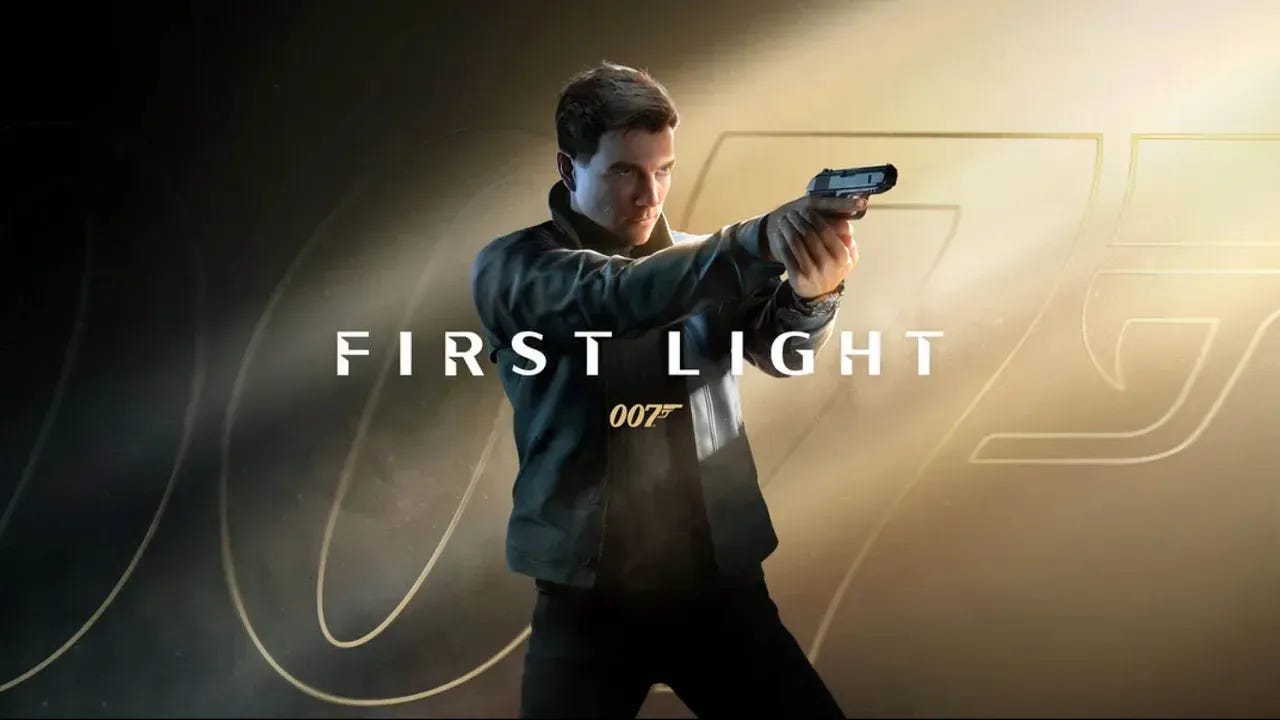
007 First Light is the best James Bond has been in years, if not decades—or even ever.
The video game weaves together everything we love about the traditional Bond film series: the cocky quips, the absurd action sequences, the abstract title sequence and pop star-fronted song, the impossible gadgets, the supervillains and their remote lairs, and globe-trotting adventure—it’s all here. And like the early Daniel Craig-era movies, it follows a young and untried Bond as he’s inducted into His Majesty’s Secret Service. Unlike other adaptations seemingly embarrassed by their source material, it’s a game that’s proud of Bond’s heritage even as it manages to avoid many of the film franchise’s worst excesses.
First Light’s gameplay makes skulking around and shooting it out with enemy goons smooth and relatively easy, though it’s nothing to write home about—save the frequent opportunities to create cinematic chaos via well-timed explosions or vehicular mayhem. Along with gorgeous graphics and excellent acting from the voice and motion-capture cast, these action set-pieces make the player feel as if they’re starring in their own Bond film.
But it’s First Light’s narrative that stands out and sets it apart both from other games and Bond media. It taps into and channels contemporary anxieties about artificial intelligence in a unique and effective way—not as the story’s main antagonist, as in the Terminator franchise or the last two Mission: Impossible movies, but as a major thread in a wider tapestry.
In First Light’s iteration of the Bond mythos, MI6 has come to rely on a quantum supercomputer named THEIA and its algorithms to guide its operations and keep the United Kingdom safe. Smart as it is, though, THEIA’s not all it’s cracked up to be—as we learn on the game’s very first mission, where Bond defies the exceptionally bad odds the computer gives him to rescue a science team held captive all while destroying the sensitive technology MI6 wanted to retrieve. He’s then recruited into a revived 00 program by the new head of MI6 (Priyanga Burford taking on the role of M), who fears her agency has become too dependent on THEIA for basic intelligence and espionage work.
As the game proceeds, it turns out M’s fears are well-founded: THEIA, Bond discovers, has chronically fed MI6 bad information over the years—and that its creator sends his own private wet-work team (led, naturally, by his less-than-stable son) out to make certain that reality conforms to THEIA’s predictions. Indeed, one of these hallucinations framed a trio of 00 agents, led to the temporary shut-down of the entire program, and left Bond’s mentor in espionage, John Greenway (a memorable Lennie James), emotionally and professionally scarred. Things go on from here in typical Bond fashion, with Bond going rogue and working with a femme fatale of dubious allegiances to infiltrate a spectacular Antarctic supervillain lair while leaving the usual trail of wanton destruction and incapacitated goons in his wake.
In the end, MI6 winds up without THEIA—leaving M to rely entirely on a newly-minted 007 to get the agency’s job done moving forward.
As excellent as First Light is purely as a Bond experience, it succeeds in large part because it actually tackles wider themes with a subtlety that Bond films never really do in more than marginal ways. Its treatment of artificial intelligence in particular provides a much better and more lucid reflection on our collective apprehension over this new technology than the apocalyptic fever dreams of Silicon Valley technologists or the now-cliché evil supercomputers of films like 2001 and The Terminator. In the world of First Light, artificial intelligence is a useful but deeply flawed and fallible tool—one that some believed could replace human spycraft entirely.
From the very beginning of First Light, Bond stands for the exact opposite: the irreplaceability of humanity in a world of artificial intelligence and quantum supercomputers. After all, he beats the terrible odds THEIA gives him right out of the gate and exposes its imperfections before taking down its villainous creator Sir Nicholas Webb (Anthony Howell) and his henchman son Damien (Bart Edwards). In a perverse way, though, so too does Webb’s effort to retcon THEIA’s errors and maintain his company’s reputation and, by extension, its profits. That MI6 ultimately has no choice but to rely on Bond and his fellow human 00 agents reveals quite a lot about the game’s underlying themes and motifs—something of a remarkable irony given the medium.
Again, it’s all pretty heady stuff for a Bond franchise that’s always been much more about escapism and wish fulfillment than anything else. After all, it’s fun to imagine a world of suave, jet-setting secret agents who routinely save the world from the schemes of unhinged supervillains.
But First Light also gives us a model for how fiction (and indeed our own real-world discussions) ought to handle artificial intelligence: namely, as a potentially powerful tool that’s nonetheless prone to error and often fallible rather than a god-like entity bent on humanity’s doom. What really matters is how those in possession of such a tool choose to use or abuse it. As impressive as its predictive algorithms and computing power may be, artificial intelligence remains no substitute for humanity—no matter how desperately many people in the upper echelons of society may want to make it so.
Bond himself doesn’t need to rage against the machine in First Light, he merely needs to know this new technology’s limits and maintain his own humanity in the face of supreme adversity. That’s something we seem to have forgotten in our stampede to insert artificial intelligence into just about every aspect of human life—almost certainly to our own peril.